
Notes / Methodology
Reminderly.ai vs Tasks.Bot for CRM Integration Automation
Your CRM holds every lead, but nobody follows up until the task is buried in another dashboard. Some tools promise automation and deliver a settings page your sales team never opens. Meanwhile, deals sit untouched for days.
This comparison walks through what Tasks.Bot actually does, from WhatsApp-based task assignment to CRM workflow automation, voice notes, GPS tracking, and face-verified attendance. You will also see how its pricing, beta availability, and free trial stack up, so you can decide whether it fits your team's follow-up process.
What Is Tasks.Bot?
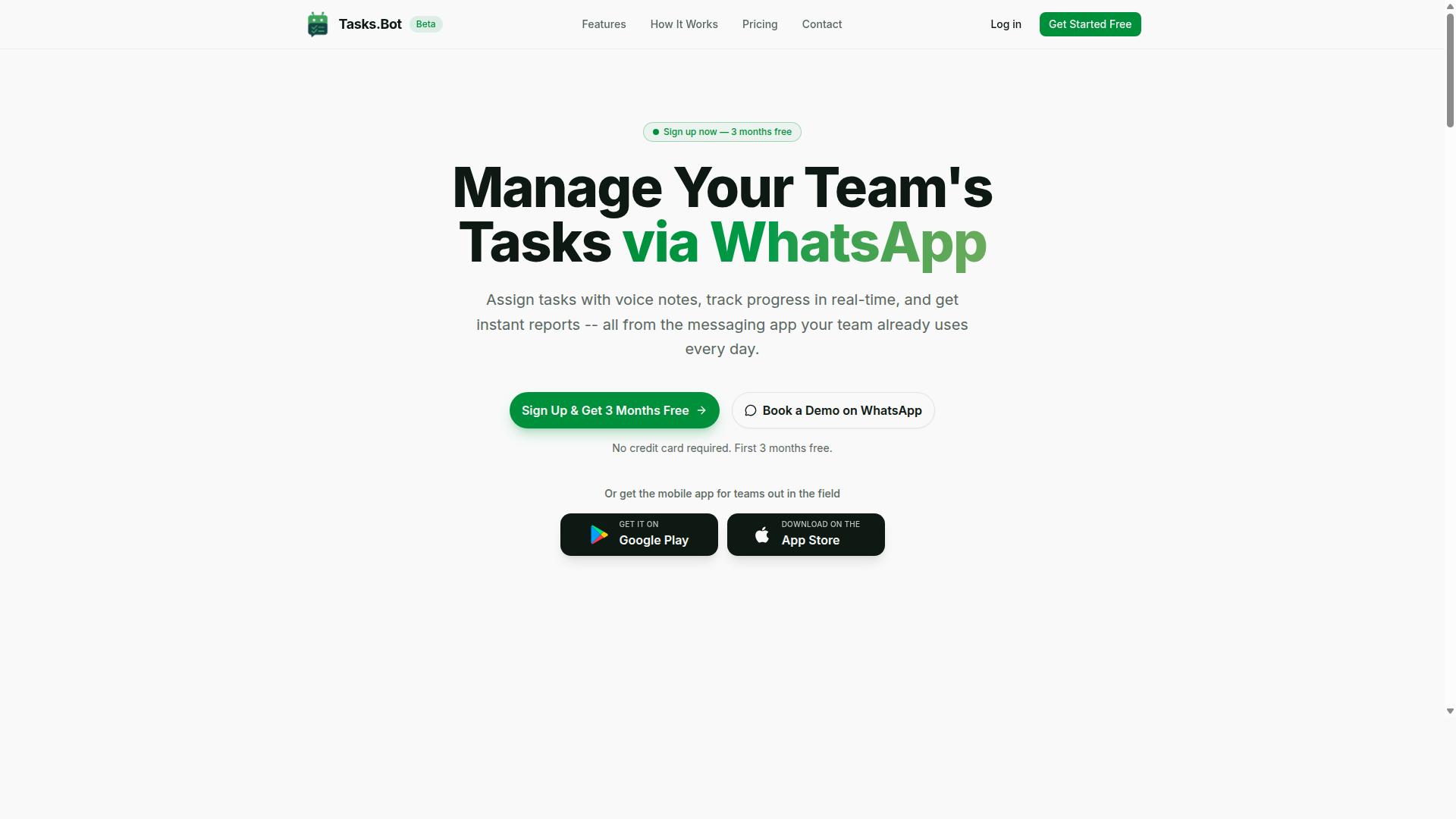
Tasks.Bot is a task management platform that operates entirely within WhatsApp, enabling teams to assign tasks, track progress, and receive reports without leaving the messaging app. Instead of asking people to adopt yet another dashboard or project tool, it meets them where they already spend their working hours.
That WhatsApp-native design is the core of the product's appeal. Because the platform lives inside a messaging app the team already uses, there is no new software to install and no separate account to create for everyday users. A message thread becomes the workspace.
Tasks.Bot also offers a mobile app for field teams, which matters for staff who are rarely at a desk. The service is currently in beta and offers a free trial period, so teams can evaluate how it fits their routines before committing.
For anyone comparing CRM integration automation options, this positioning is worth noting. Tasks.Bot is not built around a sprawling integration marketplace. It is built around a single, familiar channel, and that simplicity shapes how it fits into a broader customer relationship management and workflow automation setup.
Who Tasks.Bot Serves and How It Works via WhatsApp
Tasks.Bot is designed for teams that already use WhatsApp for communication, particularly those with field staff who need task management, attendance tracking, and payroll-ready hours. The site mentions hundreds of teams already using the service, which suggests the model resonates with operations that run on chat rather than email.
The mechanics are straightforward. Users can assign tasks, receive reminders, and submit updates through chat, so the conversation itself carries the work forward. A manager sends a task in WhatsApp, and the person on the ground replies with progress or completion, all in the same thread.
Several capabilities stand out for this audience:
- Task assignment through WhatsApp messages rather than a separate interface
- Reminders delivered in the same chat where the task was given
- Progress updates submitted conversationally by team members
- Attendance tracking for staff working away from a central office
- Payroll-ready hours captured as a byproduct of normal activity
The mobile app complements this for field teams, giving them a dedicated option when chat alone is not enough. For organizations weighing CRM integration automation, the appeal is less about API connectivity or webhook support and more about adoption: when the tool lives in WhatsApp, there is little training overhead and few excuses for tasks to fall through the cracks.
That low-friction experience is where Tasks.Bot stands apart. Teams get task management, attendance tracking, and reporting without disrupting the communication habits they already have.
Does Tasks.Bot Support CRM Integration Automation?
Tasks.Bot does not natively work together with CRM platforms, but it can be connected to CRM systems through third-party automation tools like Zapier, Make, or n8n using its API and webhook support. That distinction matters because it shapes what CRM integration automation actually looks like with this tool.
Tasks.Bot is not a customer relationship management platform. It does not store contact records, track deal stages, or manage a sales pipeline on its own. What it does is handle the task layer of a workflow: creating, assigning, reminding, and tracking the work that follows a CRM event.
That makes it a natural fit for the execution side of CRM automation. A CRM like HubSpot or Salesforce holds the relationship data. Tasks.Bot holds the follow-through. When the two are connected, a new lead, a closed deal, or a missed call in the CRM can trigger a task in Tasks.Bot automatically.
The connection runs through API connectivity and webhook support. A no-code automation platform listens for a trigger in the CRM, then sends the action to Tasks.Bot. For example:
- Trigger: a new lead is added to the CRM. Action: Tasks.Bot creates a follow-up task for the assigned rep.
- Trigger: a deal moves to a new stage. Action: Tasks.Bot opens an approval request for a manager.
- Trigger: a contact's renewal date approaches. Action: Tasks.Bot sends a recurring reminder to the account owner.
Tasks.Bot's native home is WhatsApp, which means tasks land where field and sales teams already spend their time, with no new app to install. For teams weighing Reminderly.ai against Tasks.Bot for CRM integration automation, the practical answer is that Tasks.Bot works as the action layer beside a CRM rather than as a replacement for one.
How Tasks.Bot Automates Reminders, Assignments, and Approvals
Tasks.Bot automates task assignments, deadline reminders, and approval workflows using AI to interpret natural language and voice notes, ensuring tasks are routed and tracked without manual intervention. This is the part of the product that does the heavy lifting inside a CRM-driven workflow.
Assignment automation is the first layer. Rules can route a task to the right person the moment it is created, so a lead from the sales pipeline lands with the correct rep. Because the AI understands natural language and voice notes, a manager can speak a task into WhatsApp and have it routed without opening a dashboard.
Smart deadline reminders form the second layer. Rather than firing the same notification to everyone, these reminders adapt to user behavior, nudging people based on how they actually work. In a CRM context, this is what keeps follow-up sequences from stalling after a sales call, an unanswered email, or a demo that needs a next step.
Approvals are the third layer. Completing one task can trigger an approval chain, so a discount request or a contract sign-off moves to the right decision-maker automatically. Conditional logic decides who approves and what happens next.
Put together, these three layers cover the whole loop:
- A trigger fires from the CRM, such as a new lead or a stage change.
- Tasks.Bot assigns the resulting task and tracks its deadline.
- Completion triggers the next action, whether that is an approval, a reminder, or a handoff.
Tasks.Bot also supports instant reports, tasks on a map, a live day tracker, face-verified attendance, and shifts, leave, and hours management, all inside WhatsApp with Android and iOS apps for push notifications and voice capture. Enterprise-grade encryption protects the data, and conversations and task data are never shared or used for training. A 3-month free trial with no credit card required lets teams test the workflow before committing.
Key Features Relevant to CRM Workflows
Tasks.Bot offers several features that are particularly useful for CRM-related workflows, including voice note task creation, smart deadlines, and instant reporting. These features map directly onto the daily demands of customer relationship management: capturing activity, keeping follow-ups on schedule, and showing managers what actually happened.
Unlike standalone CRM plugins, Tasks.Bot operates entirely within WhatsApp. Team members do not need to install anything or create new accounts, which removes the biggest barrier to CRM adoption: getting sales and support staff to log their work consistently. When logging is effortless, the CRM record stays accurate.
The features below support three core CRM needs. Data entry becomes a byproduct of normal conversation. Task tracking keeps follow-up sequences and deal-stage actions from slipping. Reporting gives managers real-time visibility without chasing updates.
Tasks.Bot also provides Android and iOS apps with push notifications, voice capture, and a home screen widget, so field and office staff can stay connected to the same task flow. Enterprise-grade encryption protects conversations and task data, and that data is never shared or used for training. For teams evaluating CRM integration automation, these are the capabilities worth understanding first.
Voice Notes, Smart Deadlines, and Instant Reports
Tasks.Bot allows users to create tasks via voice notes, automatically sets smart deadlines based on task context, and generates instant reports on task status and team performance. The service uses AI to understand user intent and create tasks from messages, so a spoken update becomes a structured record rather than a lost chat thread.
Voice note task creation matters for CRM work because sales reps spend most of their day talking, not typing. A rep leaving a client meeting can send a voice note describing the next step, and the task is captured without opening a laptop or a CRM form.
Smart deadline reminders handle the timing side. Rather than relying on a rep to remember a follow-up date, the system keeps deadline tracking active so nurture sequences and deal-stage actions stay on schedule. Recurring reminders suit account management routines that repeat weekly or monthly.
Instant reports give managers a live view of task completion and team performance. In a CRM context, this supports activity logging and performance tracking without manual data synchronization. Instead of exporting spreadsheets and reconciling records, managers can review what was assigned, what was completed, and what is overdue.
Together, these three features reduce the friction that causes CRM data to go stale. Tasks created by voice, deadlines that hold their own, and reports that update in real time all feed cleaner information into whatever customer relationship management system the business already uses.
Field Team Tools: GPS Tracking and Face-Verified Attendance
For field teams, Tasks.Bot includes GPS tracking and face-verified attendance, ensuring accurate location and time logs that can be synced with CRM or payroll systems. These tools matter most for businesses whose sales or service staff work outside the office.
Tasks on a map let managers see where field work is happening. When a sales rep visits a client location, the location record provides verifiable evidence of the visit. That record can then be logged as an activity against the right contact or account, keeping the CRM history grounded in what actually occurred.
Face-verified attendance confirms that the person on site is the person scheduled. This supports accurate shift, leave, and hours management, and it reduces disputes over timekeeping. For payroll and client records alike, the value is data accuracy.
Consider a distribution business with reps visiting retail outlets. Each visit needs a location stamp, a time entry, and a note about what was discussed. With GPS tracking and face-verified attendance, the visit produces a reliable log that can flow into the CRM as an activity record and into payroll as verified hours.
These field tools complement the WhatsApp-based task flow rather than replacing it. Staff still work from the app they already use, while managers gain the location and attendance detail that field operations depend on. The result is a single, consistent record of field activity that CRM and payroll systems can both trust.
Pricing and Plans
Tasks.Bot offers a single 'Full Access' plan with all features included, priced at ₹200 per member per month or ₹1,200 per year per member, with pricing available in both Indian Rupees and US Dollars.
This flat structure removes the usual tier comparison exercise. There is no Basic versus Pro versus Enterprise ladder to weigh, and no feature held back for a higher bracket. Every capability the platform offers sits inside the one plan, so the decision comes down to seat count and billing cycle rather than feature negotiation.
| Plan | Billing Cycle | Cost per Member | Notes |
|---|---|---|---|
| Full Access | Monthly | ₹200 per month | All features included |
| Full Access | Annual | ₹1,200 per year | Save 50%, save ₹1,200/yr per member |
For teams weighing CRM integration automation, the annual route is the clear value pick. Paying yearly works out to 50% less than twelve monthly payments, a saving of ₹1,200 per member each year. A five-person sales team on the annual plan, for example, pays ₹6,000 for the year instead of ₹12,000 spread across monthly charges.
Currency selection matters for distributed teams. The site presents a 'Select currency' option covering Indian Rupee and US Dollar, so buyers outside India can view figures in a familiar denomination. Because rates and display settings can shift, it is worth confirming the final currency at checkout before committing.
New users also receive 3 months free, with no credit card required and the ability to cancel anytime. That trial window gives a team room to test trigger-based actions, recurring reminders, and follow-up sequences against real contact management data before any payment is due.
One practical note: Tasks.Bot is currently in beta. Buyers should check the footer for the refund policy, since terms during a beta period can differ from a general release. Reviewing that policy alongside the free trial period gives a complete picture of the financial commitment before signing up.
Trust Signals and Current Availability
Tasks.Bot is currently in beta, with hundreds of teams already using it, and offers a refund policy as stated in the website footer. Those three facts matter when you are evaluating any tool for CRM integration automation, because they tell you the product is real, actively used, and backed by a stated commitment to buyer protection.
Beta status is worth understanding rather than fearing. A tool in beta is still being refined, which means the team behind Tasks.Bot is actively developing the product and responding to how real users apply it. Hundreds of teams already working inside the platform gives you a live user base to learn from, not an empty promise.
The refund policy in the footer adds a practical layer of confidence. If the tool does not fit your workflow automation needs, there is a documented path to recover your spend. That is a meaningful signal for anyone comparing options before committing.
Availability is straightforward. Tasks.Bot is a SaaS product available globally, so location is not a barrier to adoption. You can access it through WhatsApp and mobile apps, which fits teams that manage reminders, follow-ups, and task management on the move rather than from a desk.
If you want to see how it works before committing, the website includes a Book a Demo on WhatsApp option. That gives you a direct, low-friction way to explore the product with a real conversation instead of a static sales page. For teams weighing a CRM integration automation decision, that kind of hands-on preview is often more useful than any feature list.
Who Should Choose Tasks.Bot for CRM Integration Automation
Tasks.Bot is ideal for teams that rely on WhatsApp for communication and need to integrate task management with their CRM, especially those with field staff requiring attendance and location tracking. Instead of forcing people to open a desktop dashboard, it meets them in the messaging app they already use every day. That single choice shapes which organizations get the most value from it.
The service is built for teams that use WhatsApp for communication, particularly those with field staff who need task management, attendance tracking, and payroll-ready hours. Hundreds of teams already use it. If your sales or service operation runs on chat threads and voice notes rather than email chains, this approach fits naturally.
CRM integration automation matters most when follow-up work is tied directly to customer records. Tasks.Bot connects task management to that workflow, so a CRM update can lead to an assigned action rather than a note nobody revisits. The value is in closing the gap between logging activity and actually doing the next step.
Several profiles tend to benefit most:
- Small and medium businesses that want task management and customer follow-up without adopting a heavy platform.
- Field sales teams that need attendance tracking and location context alongside their customer tasks.
- Remote teams on WhatsApp that coordinate through chat and need assignments, reminders, and deadlines in one place.
- Operations with hourly or shift staff that want payroll-ready hours captured as work happens.
Consider a field sales rep who finishes a customer visit and updates the deal record. With CRM integration automation, that update can trigger a follow-up task assigned to the right person, with a deadline attached. The rep never has to remember to create it manually, and the manager can see the activity in context.
Remote teams see similar gains. A support or account team coordinating over WhatsApp can turn a customer request into a tracked task, keep recurring reminders running, and log the outcome back to the customer relationship management record. Attendance and hours flow into the same system, which keeps payroll data consistent with the work actually performed.
Tasks.Bot is not the right fit for every organization, and being honest about that helps teams choose well. Groups that need a full-fledged CRM with a deep library of native integrations, two-way sync across many objects, and advanced sales pipeline analytics may be better served by a dedicated CRM platform. The same applies to enterprises with complex data synchronization, field mapping, and compliance requirements that demand extensive API connectivity and custom webhook support.
There is also a practical middle ground. Teams already using Zapier, Make, or n8n can connect their CRM to other third-party apps through those tools, while Tasks.Bot handles the task, attendance, and messaging layer. That combination suits organizations that want no-code automation and trigger-based actions without rebuilding their entire stack.
In short, choose Tasks.Bot when your people live in WhatsApp, your work involves field staff and tracked hours, and you want task management wired to your CRM without a long rollout. Choose a traditional CRM with native integrations when your priority is deep data modeling and pipeline reporting above all else. For chat-first teams with mobile workers, Tasks.Bot is the clearer fit.
Final Verdict
Tasks.Bot provides a practical solution for teams seeking to automate task management within WhatsApp and connect it to CRM workflows via third-party tools. Rather than forcing users into yet another dashboard, it works inside a messaging app most teams already have open all day. That single design choice shapes both its strengths and its limits.
The core appeal is WhatsApp-native operation. There is no new app to install, no adoption curve to fight, and no separate login for field teams or sales reps who live on their phones. For organizations where WhatsApp is already the default channel for customer conversations, that familiarity matters more than a longer feature list.
On the automation side, Tasks.Bot handles the essentials of task management and workflow automation: trigger-based actions, conditional logic, recurring reminders, deadline tracking, and follow-up sequences. These are the building blocks that keep a sales pipeline moving, from lead nurturing through later deal stages. An AI scheduling assistant layer reduces the manual effort of assigning and chasing work.
CRM connectivity is where the picture becomes more nuanced. Tasks.Bot does not offer native integrations with major customer relationship management platforms. Instead, connections are built through third-party apps such as Zapier, Make, or n8n, or through API connectivity and webhook support. That approach works well for teams comfortable with no-code or low-code automation builders, but it does mean data synchronization, field mapping, and two-way sync require some initial configuration rather than a one-click setup.
Pricing and audience follow the same pattern. Tasks.Bot suits small and mid-sized teams, agencies, and sales groups that want automation without abandoning WhatsApp. It is less suited to enterprises that need deep, pre-built connectors to a specific CRM out of the box.
- Pros: operates inside WhatsApp, minimal training required, AI-powered scheduling, flexible automation through third-party tools and APIs, useful for recurring reminders and deadline tracking
- Cons: no native CRM integrations, relies on external platforms for data synchronization, currently in beta status, so some features may still evolve
Compared with a dedicated AI scheduling assistant that assumes a desktop-first workflow, Tasks.Bot wins on accessibility. The trade-off is that teams wanting instant, native CRM connections will need to invest time in setup. For many small and mid-sized operations, that is a reasonable exchange.
Overall, Tasks.Bot is a credible, focused tool rather than a bloated suite. If your team already runs customer conversations on WhatsApp and wants automation without a new app, it is worth a closer look. If your priority is out-of-the-box native integrations with a specific CRM, evaluate the setup effort first.
For questions, a walkthrough, or to book a demo, reach the team at hello@tasks.bot or call +91 97143 42522.
Frequently Asked Questions
What makes Tasks.Bot different from Tasks.Bot-style CRM integration automation tools?
Tasks.Bot is a task management platform that runs entirely inside WhatsApp, so your team can assign tasks, get reminders, and receive reports without installing new software or creating extra accounts. For teams already using WhatsApp as their main communication channel, that means CRM-related follow-ups and task automation happen where the work already is. Tasks.Bot also supports voice note task creation, automatic task assignment, and instant reports, plus a mobile app for field teams.
Do we need to install anything or train our team on a new app to use Tasks.Bot?
No. Tasks.Bot operates within WhatsApp, so team members don't need to install anything or create new accounts to get started. Tasks are created and tracked through natural language and voice notes, which keeps the learning curve low. A mobile app is also available for field teams who need it.
Can Tasks.Bot handle task assignment and deadline follow-ups automatically?
Yes. Tasks.Bot includes automatic task assignment, smart deadline reminders, and approvals and automations, so recurring follow-ups don't depend on someone remembering to chase them. It also provides instant reports and a live day tracker, giving managers visibility without manual check-ins. These features are part of the Full Access plan, which includes all features.
How much does Tasks.Bot cost, and is there a free trial?
Tasks.Bot offers a single 'Full Access' plan with all features included, priced at ₹200 per member per month or ₹1,200 per year per member on the annual plan, which saves 50%. Pricing is available in both Indian Rupees and US Dollars. For current trial details, it's best to reach out directly, as the service is currently in beta.
Is Tasks.Bot suitable for field teams that need attendance and hours tracking?
Yes. Tasks.Bot is designed for teams that use WhatsApp for communication, especially those with field staff who need task management, attendance tracking, and payroll-ready hours. It offers face-verified attendance and tasks on a map, so you can see both who showed up and where the work is happening. This makes it a practical fit for field operations, not just office-based CRM workflows.
How do we get started or see Tasks.Bot in action?
You can book a demo directly on WhatsApp from the Tasks.Bot website, which lets you experience the workflow in the same place your team would use it. For questions, contact hello@tasks.bot or call +91 97143 42522. Tasks.Bot is available worldwide as a SaaS product, and the site mentions a refund policy in the footer.
Recommended Resources: